March 16, 2026
•
2 min read
Isolated Cloud opens Cloud to regulated organizations. A dedicated, single-tenant environment managed by Atlassian removes the shared-infrastructure blocker.
It's still a full Cloud migration. The same Data Center vs. Cloud differences apply, so preparation and early security involvement matter most.
Rebuild the experience, don't just move content. Refined runs inside the isolation boundary, so you can build a structured Confluence front door before cutover.
DC end of life accelerates Cloud migration, but not every organization can adopt Commercial Cloud. Here's what Atlassian Isolated Cloud is, where it fits, and what it means for your migration.
Cloud migration is gathering even more pace with the upcoming Data Center end of life, but one group of organizations has watched from the sidelines: banks, insurers, healthcare and life-sciences companies, defense contractors, and anyone whose security review won't accept shared infrastructure. For them, "just move to Cloud" was never that simple.
Atlassian Isolated Cloud changes that calculation. This guide covers what Isolated Cloud actually is, where it sits among Atlassian's deployment options, and — the part that matters most once the decision is made — what it means for planning your Refined migration.
Over the past few years, we've heard from many Data Center customers that Commercial Cloud doesn't meet their rigorous requirements.
Technically, this has been a massive lift. But being able to offer something that matches what our customers truly need has always been a top priority for us.
— Janette Hagerlund, CTO, Refined
Atlassian Isolated Cloud is a single-tenant version of Atlassian Cloud. Where standard (multi-tenant) Cloud keeps customers' data logically separated on shared infrastructure, Isolated Cloud gives your organization its own dedicated compute, storage, and networking inside a virtual private cloud — managed by Atlassian rather than by you.
In practice, that means:
What it isn't: it's not Data Center relocated to the cloud — you're not running servers, Atlassian is. And it's not a way to skip migration. Moving into Isolated Cloud is still a Data Center to Cloud migration, with everything that entails.
It helps to see the three deployment models side by side:
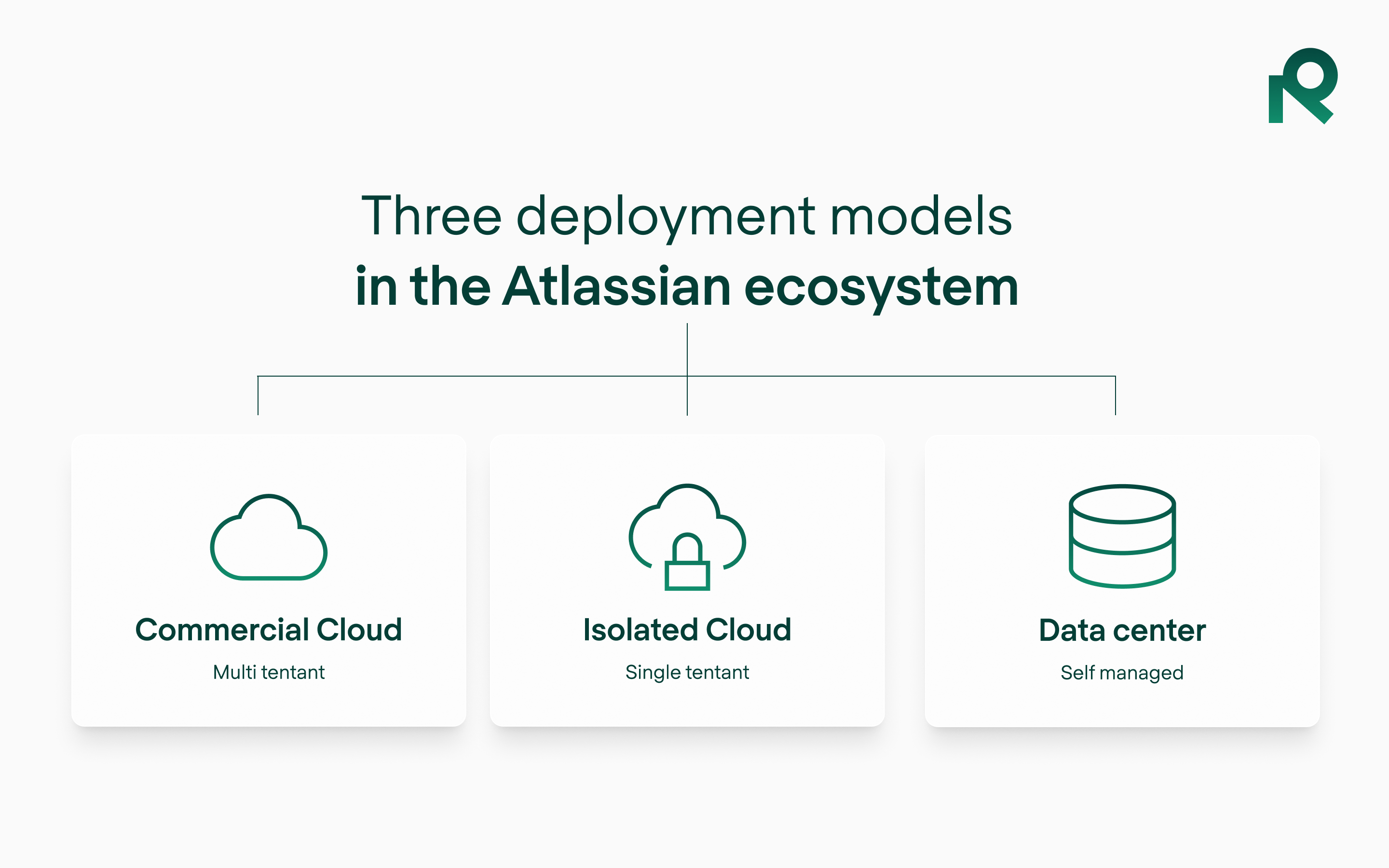
Atlassian positions Isolated Cloud for large enterprises with strict data-isolation requirements that prevent adopting shared Commercial Cloud — most often financial services, public sector, healthcare, and critical infrastructure. It carries the Cloud Enterprise feature set plus Guard Premium, and Atlassian's Isolated Cloud currently supports Confluence, Jira, and Jira Service Management. (Refined's Isolated Cloud support is Confluence-only for now — more on that below).
If your organization delayed their Data Center end of life migration specifically because shared cloud couldn't clear internal risk review, this is the option built for that situation.
The infrastructure is different; but the migration is familiar. Moving from Data Center to Isolated Cloud involves the same fundamentals — and the same opportunities — as any Cloud migration: it's the moment to restructure content, revisit macros and apps, reset permissions cleanly, and redesign the experience for how people actually work in Cloud. Isolated Cloud changes where your instance runs; the path to get there is the same proven one thousands of teams have already taken.
Isolated Cloud exists to satisfy exactly the requirements your security, compliance, and legal teams care about, so this is an infrastructure project where they're natural allies. Bringing them in early means architecture, data-handling, and approvals get worked out together, and the plan comes out stronger for it. It does take planning, so build their reviews into the timeline from the start rather than treating them as a final gate.
It makes sense when you have regulatory or contractual data-isolation requirements, when data sensitivity or sovereignty rules out shared cloud, or when internal governance won't approve multi-tenant infrastructure.
It makes sense when you have regulatory or contractual data-isolation requirements, when data sensitivity or sovereignty rules out shared infrastructure, or when internal governance won't approve multi-tenant infrastructure.
For most other organizations, Commercial Cloud is the right home: it already meets high security and compliance standards, at a fraction of the cost. Isolated Cloud carries a real price premium and added operational complexity because it solves one specific problem — dedicated infrastructure — so it's a deliberate choice for teams with a genuine isolation requirement, not a default upgrade. Match the option to the requirement.
This is worth being direct about, because candor is what earns trust with the people scrutinizing your plan: the differences between Data Center and Cloud still apply. Macros behave differently. Page editors differ. change. Some apps work differently or need Cloud equivalents.
Isolated Cloud changes the walls around your instance, not the contents you're moving in. Teams that treat it as a shortcut get surprised. Teams that plan for a genuine migration don't.
Read Refined’s migration guides for information on differences between Refined apps on DC and Cloud.
Refined is the experience layer for Atlassian Confluence and Jira Service Management — the structured, governed front door that turns native Atlassian content into something your audiences can actually navigate.
On Isolated Cloud, Refined currently supports Confluence, so the guidance below is written for a Confluence migration; Refined for Jira Service Management support on Isolated Cloud isn't available yet.
A few practical guidelines on deciding on your Refined migration and how to go about it:
See your own migration path before you commit. The migration advisor maps your situation — what carries over cleanly, what needs rework, and where the real effort sits — so you walk into stakeholder reviews with a plan instead of a guess.
Prepare with a clear picture of what changes. A structured preparation guide walks you through the parts that trip teams up — macro differences, layout changes, permission adjustments — before they become launch-day problems. In a high-stakes environment, fewer unknowns is most of the battle.
Rebuild the experience, not just relocate the content. A migration that only moves content leaves you with the same raw Confluence in a new place. Refined runs inside your Isolated Cloud environment — within the same isolation boundary, not bolted on outside it — so you can rebuild a structured, audience-aware front door on top of Confluence: curated navigation, reusable layouts, and consistent theming. Stand it up in parallel to test and refine before you switch anyone over. After cutover, that's what drives adoption and protects the Confluence investment you just migrated, instead of leaving people to relearn where everything lives.
A few principles keep complex migrations on track:
Isolated Cloud adds scrutiny and stakeholders, which can make a migration feel heavier than it needs to be. But what determines whether a migration goes well was never the environment — it's the preparation. Know what's changing, plan for the rework, and rebuild an experience people will actually use on the other side.
Two ways to start:
Raj Sehmi is on the product marketing team at Refined, the experience layer for Atlassian Confluence and Jira Service Management.