April 23, 2026
•
4 min read
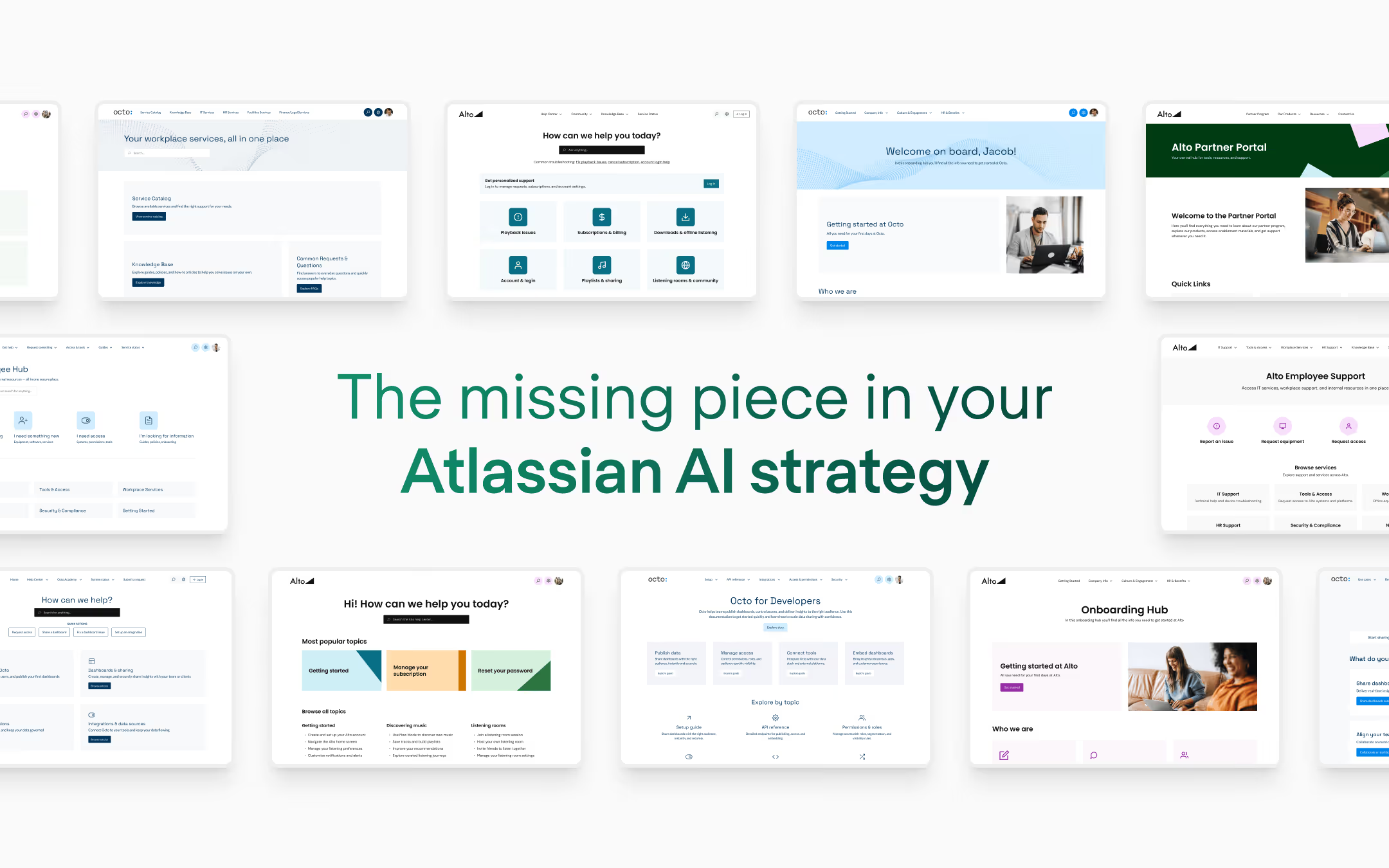
AI is transforming knowledge and service — but in the Atlassian ecosystem, it's exposing a problem most teams haven't solved yet. The experience layer can make all the difference.
If you’re reading this, you probably don’t need me to explain Atlassian’s evolution over the past few years. It’s evolved from a set of developer tools into something broader and bolder — a System of Work that connects teams, knowledge, and services across an entire organization.
Confluence is the knowledge layer. Jira Service Management is the service layer. Jira for developers. Etc. Together it’s a shared foundation that, in theory, gives every employee, customer, and partner a way to get things done.
In practice, it’s more complicated than that.
As these platforms scale — more teams, more content, more request types, more audiences — they become harder to navigate for the people who rely on them to retrieve knowledge or support. Employees land on a Confluence space and face a giant page tree, built by and for the people who created the content, not the people who need to find it. Customers arrive at a JSM portal and guess which request type to use. External partners are lost in native interfaces that feel unfamiliar. Support teams answer the same questions week after week because the answers exist — they’re just not easily findable for the people who need them.
The System of Work is powerful. But for the people living inside it every day, and for non-daily users, it can feel more overwhelming than empowering.
This gap — between what Atlassian makes possible and what users actually experience — is what I’d call the experience problem. And I’d argue it’s both the most underrated challenge in the Atlassian ecosystem right now and the biggest opportunity in terms of solving more business problems with your Atlassian investment.
The way we think about solving this at Refined is through what we call the experience layer.
The experience layer isn’t a design system or a site-builder or a theming tool. It’s the structured, governed infrastructure that sits between your Atlassian content and the people who need what’s inside it. It’s what turns a Confluence space into a knowledge hub that your resellers can actually navigate. It’s what transforms a JSM portal into a help desk that guides users to the right request on the first try—whether via AI or their own discovery—rather than the third.
Practically, that means defining your audiences and building curated experiences for each of them. It means structured navigation that reflects how users think, not how content was organised. It means governing what’s visible to whom — so employees see what’s relevant to their role, customers see only what they’re meant to see, and partners get a coherent experience that reflects your brand.
It means context: knowing who is asking, and shaping what they find accordingly.
When the experience layer is working, users stop asking “where do I go?” They find answers before they raise tickets. Knowledge gets used instead of buried. The Atlassian investment stops being a platform that power users navigate and starts being something the whole organization benefits from—and one you can leverage to serve external users, too.
Done well, it’s not even visible. That’s the goal.
Which brings me to the conversation I think we’re not having about AI.
Everyone in the ecosystem is excited about AI — and rightly so. The speed at which AI can surface information, summarize content, and accelerate workflows is genuinely impressive. We’ve been building with it. Our customers are asking for it.
But here’s the thing. AI doesn’t fix the experience problem. In fact, it can amplify it.
When you layer AI onto a fragmented, unstructured knowledge environment, you get faster access to more noise. Better search over a poorly organized knowledge base isn’t a solution — it’s a more efficient path to confusion. AI surfaces more content. Without structure and context, that’s more overwhelm, not less.
The organizations I’ve seen get the most out of AI in their Atlassian environments have one thing in common: they did the structural work first. They defined their audiences. They built curated experiences for each of them. They governed what’s visible to whom. And then they adopted AI on top of a foundation that was already working.
When AI operates inside a structured, governed context, something changes. Answers are scoped to what’s relevant. Results reflect who’s asking. Users trust what they find, because what they find was designed for them. AI stops being a search engine bolted onto chaos and starts being a genuine productivity multiplier.
The most exciting thing about getting the experience layer right isn’t just that it solves today’s navigation problem. It’s that it creates a compounding cycle — one where each improvement feeds the next.
Think of it in three movements.
One: You build the experience—structured, audience-aware front doors that deliver knowledge and service to the right people through the right interface, whether that’s a traditional site, an AI chat, or increasingly, an agent.
Two: That experience generates signals: where users succeed, where they drop off, what they’re searching for and not finding.
Three: Those signals inform optimization: closing knowledge gaps, improving request flows, tightening the context that makes AI more accurate. Better foundations produce better experiences.
And the cycle continues.
This is what we mean when we talk about knowledge and service as a continuous improvement engine, not a one-time implementation. The organizations that build this foundation now — structured context, governed audiences, experience-led delivery — will be the ones best positioned to deploy AI with confidence as the technology matures.

This is a harder conversation to have than “look how fast our AI can answer a question.” But I think it’s the right one for anyone serious about getting lasting value from their Atlassian investment.
The organizations that will lead on knowledge and service over the next few years won’t be the ones who adopted AI the fastest. They’ll be the ones who built the right foundation for it to work.
That starts with the experience.
Emil Sjödin is CEO and Co-Founder of Refined, the AI-powered experience layer for Atlassian knowledge and service.